Pharmaceutical manufacturers are under increasing pressure to improve production efficiency while maintaining product quality, process consistency, traceability, hygiene, and regulatory compliance. In liquid oral manufacturing, manual operations can create challenges related to process variation, operator dependency, production delays, documentation, and batch-to-batch consistency.
Automation is changing how modern liquid oral processing plants operate by integrating process equipment, sensors, control systems, automated valves, instrumentation, and digital monitoring into a coordinated manufacturing system.
From ingredient charging and mixing to heating, cooling, homogenization, filtration, product transfer, and Clean-in-Place operations, automation provides better visibility and control across the manufacturing process.
An automated liquid oral processing plant can help pharmaceutical manufacturers achieve repeatable production, improve process efficiency, reduce manual intervention, strengthen data recording, and support GMP-oriented manufacturing.
This article explains how automation is transforming liquid oral processing plants, the technologies involved, its operational benefits, and the factors pharmaceutical manufacturers should consider when investing in an automated processing system.
What Is a Liquid Oral Processing Plant?
A liquid oral processing plant is an integrated pharmaceutical manufacturing system designed to produce liquid dosage forms such as:
- Syrups
- Oral solutions
- Suspensions
- Emulsions
- Elixirs
- Liquid medicines
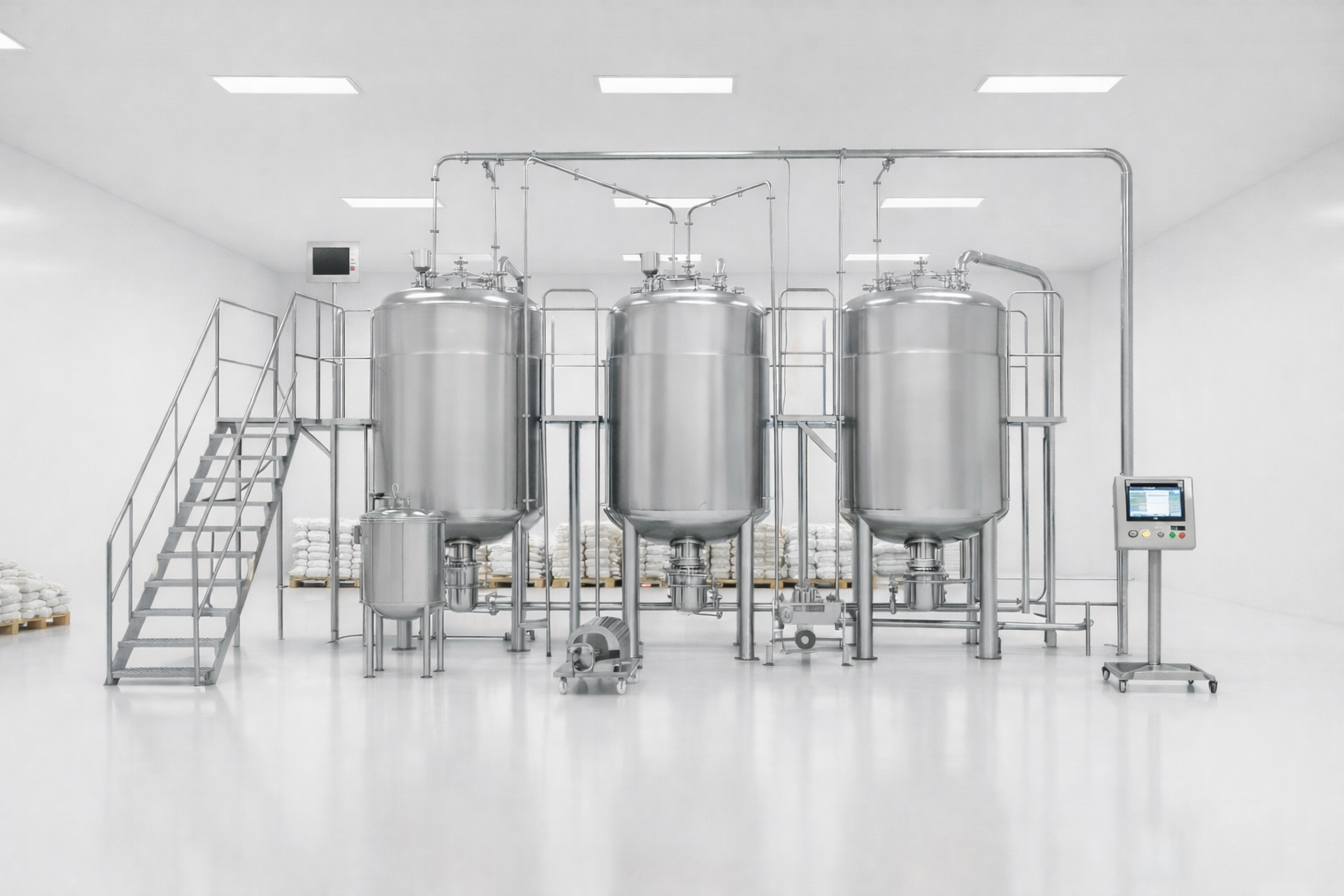
Depending on the product and process requirements, a typical liquid oral manufacturing system may include:
- Sugar syrup preparation vessel
- Manufacturing vessel
- Storage vessel
- Mixing system
- Agitator
- Homogenizer
- Heating and cooling arrangement
- Vacuum system
- Transfer pumps
- Filtration system
- Product transfer piping
- Instrumentation
- Control panel
- Clean-in-Place system
The equipment is generally designed to support hygienic production, controlled processing, efficient cleaning, and consistent product quality.
What Is Automation in a Liquid Oral Processing Plant?
Automation in a liquid oral processing plant refers to the use of programmable control systems, sensors, instruments, automated valves, and software to monitor and control manufacturing operations with reduced manual intervention.
Depending on the required level of automation, a system may control:
- Ingredient charging
- Mixing speed and time
- Product temperature
- Heating and cooling cycles
- Vessel pressure and vacuum conditions
- Liquid levels and product flow
- Homogenization
- Product transfer and filtration
- Cleaning cycles
- Process alarms
- Batch data recording
Automated systems can range from basic control panels with digital instruments to advanced PLC- and SCADA-based manufacturing systems with recipe management, data logging, audit trails, and centralized process monitoring.
Why Is Automation Becoming Important in Liquid Oral Manufacturing?
Traditional liquid oral production may depend heavily on operators to manually control mixing times, temperatures, valves, pumps, ingredient additions, and product transfers.
Manual operations can increase the possibility of:
- Process variation
- Incorrect operating sequences
- Inconsistent mixing
- Temperature deviations
- Operator-dependent results
- Production delays
- Manual documentation errors
- Limited process visibility
- Higher risk of product loss
Automation helps standardize critical process operations by ensuring that defined manufacturing parameters are monitored and controlled consistently. For pharmaceutical manufacturers, this can improve repeatability while providing better control over production activities.
Key Automation Technologies Used in Liquid Oral Processing Plants
1. Programmable Logic Controllers
A Programmable Logic Controller, commonly known as a PLC, acts as the control center of an automated liquid oral processing plant. The PLC receives data from sensors and instruments and controls equipment such as agitators, pumps, automated valves, heating/cooling systems, homogenizers, vacuum systems, and transfer systems. PLC-based automation can help ensure that process steps follow predefined operating sequences.
2. Human-Machine Interface
A Human-Machine Interface allows operators to monitor and control the manufacturing process through a digital screen. An HMI may display vessel temperature, mixing speed, liquid level, process status, batch stage, pump/valve status, alarm notifications, and cleaning-cycle progress. A well-designed HMI simplifies process monitoring and provides operators with a clear view of manufacturing activities.
3. SCADA Systems
Supervisory Control and Data Acquisition systems provide centralized monitoring and data visualization for pharmaceutical manufacturing operations. SCADA systems may support real-time process monitoring, historical data recording, trend analysis, alarm management, batch reporting, and production-performance monitoring.
4. Process Sensors and Instrumentation
Sensors provide real-time process information that enables automated control. Common instruments may include temperature sensors, pressure transmitters, level sensors, flow meters, load cells, vacuum sensors, and conductivity/pH sensors. The selection of instrumentation depends on the formulation, equipment design, manufacturing process, and quality requirements.
5. Automated Valves and Product Transfer Systems
Automated valves control the movement of materials between vessels and processing stages. They can help improve transfer accuracy, process sequencing, operator safety, hygienic product handling, and production efficiency. Automated transfer systems can also reduce manual handling and improve process repeatability.
6. Recipe Management Systems
Recipe management allows approved process parameters to be stored and used for specific products. A digital recipe may include ingredient quantities, mixing speeds and durations, heating and cooling temperatures, homogenization times, transfer sequences, and process hold times. Recipe-based automation helps reduce operator dependency and supports repeatable manufacturing processes.
7. Automated Clean-in-Place Systems
Clean-in-Place systems clean vessels, pipelines, pumps, and product-contact equipment without requiring complete dismantling. Automated CIP systems may control the cleaning sequence, water circulation, cleaning-agent dosing, temperature, flow rate, duration, and rinsing cycles. Automation can improve cleaning consistency while reducing manual cleaning effort and production downtime.
How Automation Is Transforming Liquid Oral Processing Plants
1. Improving Batch-to-Batch Consistency
Consistency is essential in pharmaceutical manufacturing. Automation helps maintain defined process parameters such as mixing speed, processing time, temperature, product flow, and homogenization conditions. By reducing variations caused by manual operation, automated systems can support more repeatable production.
2. Reducing Manual Intervention
Manual handling may increase the possibility of operating errors, process delays, and contamination risks. Automation can reduce manual intervention in valve operation, product transfer, mixing control, heating and cooling, process monitoring, and cleaning cycles.
3. Providing Better Process Control
Automated systems continuously monitor process conditions and can adjust equipment operation according to programmed parameters. For example, the system may maintain a defined product temperature, adjust heating or cooling operations, control agitator speed, stop a pump when the required level is reached, or generate an alarm when a parameter exceeds its defined range.
4. Increasing Production Efficiency
Automation can reduce the time required for repetitive operations and improve coordination between different processing stages. Potential efficiency benefits include faster batch processing, reduced waiting time, improved equipment utilization, more efficient product transfer, shorter cleaning cycles, and better production planning.
5. Supporting Process Traceability
Digital systems can record important manufacturing parameters during production. Recorded data may include batch start/completion times, product temperature, mixing duration, agitator speed, process alarms, operator actions, equipment status, and cleaning-cycle data. This information can support batch review, deviation investigation, process analysis, and quality documentation.
6. Improving Operator Safety
Automation can reduce direct operator interaction with heated vessels, moving equipment, pressurized systems, cleaning chemicals, and product-transfer operations. Remote monitoring and automated sequences may help create a safer operating environment.
7. Reducing Product Loss
Automated process control can help reduce product loss caused by overfilling, incorrect transfers, process deviations, uncontrolled mixing, and inaccurate operating sequences. Improved control may contribute to better yield and more efficient use of raw materials.
8. Supporting GMP-Oriented Manufacturing
Automation can support Good Manufacturing Practice requirements by enabling controlled process parameters, repeatable operating sequences, digital data recording, alarm management, batch traceability, standardized cleaning cycles, and user-access controls. However, automation alone does not make a liquid oral processing plant GMP-compliant; compliance depends on the complete manufacturing system including equipment design, validation, documentation, data integrity, and operator training.
Manual vs Automated Liquid Oral Processing Plants
| Process Area | Manual System | Automated System |
|---|---|---|
| Mixing control | Operator-controlled | Programmed control |
| Temperature monitoring | Manual or basic display | Continuous monitoring |
| Valve operation | Manual | Automated |
| Product transfer | Operator-dependent | Sequence-controlled |
| Process recording | Manual documentation | Digital data logging |
| Recipe control | Manual instructions | Stored process recipes |
| Alarm management | Limited | Real-time notifications |
| Batch consistency | More operator-dependent | More repeatable |
| Cleaning process | Manual or semi-automatic | Automated CIP options |
| Process visibility | Limited | Centralized monitoring |
Levels of Automation in Liquid Oral Processing Plants
Basic Automation
Basic systems may include digital temperature indicators, variable-frequency drives, local control panels, timer-based operations, and basic level controls. This level may be suitable for smaller production facilities or less complex manufacturing processes.
Semi-Automatic Systems
Semi-automatic plants may include PLC-based controls, HMI monitoring, automated mixing, temperature control, automated pump operation, and selected automated valves. Operators may still perform ingredient charging and certain transfer operations manually.
Fully Automated Systems
Advanced systems may include PLC and SCADA integration, automated ingredient dosing, recipe management, automated process sequencing, centralized monitoring, electronic batch data, automated CIP systems, alarm/event logging, and user-access controls.
Challenges When Implementing Automation
Although automation provides significant benefits, pharmaceutical manufacturers should consider several factors before implementation:
- Initial Investment: Higher initial cost because of control systems, sensors, instrumentation, automated valves, software, system integration, and validation requirements.
- System Integration: Automation components must work effectively with vessels, pumps, homogenizers, transfer piping, utility, and cleaning systems.
- Validation and Documentation: Automated equipment requires User Requirement Specification (URS), Functional Design Specification (FDS), IQ/OQ, calibration documentation, and SOPs.
- Operator Training: Training on HMI operation, process sequences, alarm response, recipe selection, manual overrides, and basic troubleshooting is essential.
- Maintenance Requirements: Regular preventive maintenance and calibration for sensors, instruments, automated valves, and electrical components.
How to Select an Automated Liquid Oral Processing Plant
Before selecting a system, manufacturers should evaluate product type, batch size, production capacity, mixing/homogenization needs, heating/cooling requirements, automation level, cleaning, data-recording, and installation support. A detailed User Requirement Specification (URS) is highly recommended.
The Future of Automation in Liquid Oral Manufacturing
Liquid oral processing plants are expected to become increasingly connected and data-driven. Future developments include Industrial Internet of Things (IIoT) connectivity, predictive maintenance, cloud-based production monitoring, advanced process analytics, digital batch records, automated quality monitoring, and integration with Manufacturing Execution Systems (MES).
Conclusion
Automation is changing liquid oral processing plants by improving process control, production consistency, efficiency, traceability, cleaning operations, and manufacturing visibility.
PLC systems, HMI interfaces, SCADA platforms, process sensors, recipe management, automated valves, and CIP systems enable pharmaceutical manufacturers to standardize critical operations while reducing dependence on repetitive manual processes. Selecting an experienced pharmaceutical processing equipment manufacturer can help ensure that the automation system is designed according to specific product, capacity, operational, and quality requirements.