
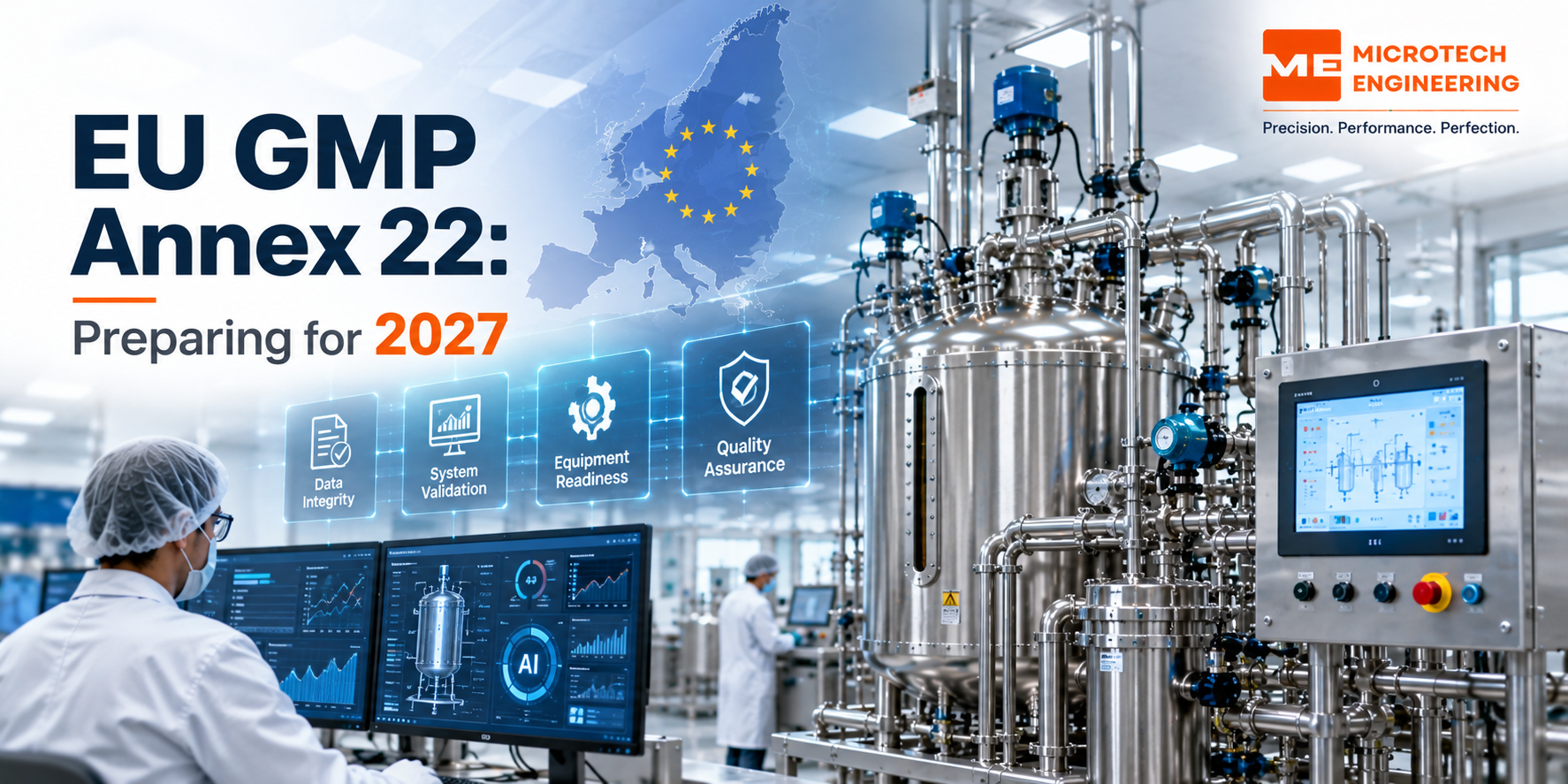
Artificial intelligence is becoming an increasingly important part of pharmaceutical manufacturing. From predictive maintenance and process monitoring to automated inspection and advanced analytics, AI offers manufacturers new ways to improve operational visibility, consistency and decision-making.
However, introducing AI into pharmaceutical manufacturing raises an important question: How can manufacturers use AI while maintaining GMP compliance, product quality, data integrity and patient safety?
This is the context behind EU GMP Annex 22: Artificial Intelligence, a proposed addition to the European Union's Good Manufacturing Practice guidelines for AI and machine learning used in pharmaceutical manufacturing.
For Indian pharmaceutical companies supplying medicines to European markets—or planning to expand their regulated-market presence—Annex 22 is an important development to monitor. The proposed guidance focuses on areas such as intended use, AI model selection and validation, training and test data, performance evaluation, explainability, and ongoing oversight for EU GMP Annex 22 compliance and pharmaceutical equipment.
Regulatory Status Update: As of October 2026, published information from the European Medicines Agency (EMA) indicates that Annex 22 has been undergoing further development following stakeholder consultation and expert workshops. The EMA's work plan targeted delivery of a final text to the European Commission in Q4 2026. This target is not confirmation that a final guideline has been published or that a specific implementation deadline is in force. Manufacturers should verify the latest official publication before making compliance decisions.
For Indian manufacturers planning equipment purchases, automation projects and plant upgrades for 2027, the practical question is how to prepare now without treating a draft as an already binding requirement.
What Is EU GMP Annex 22?
EU GMP Annex 22 is a proposed guideline addressing the use of artificial intelligence in the manufacture of active substances and medicinal products. It was developed as part of a broader initiative to modernise EU GMP guidance in response to the growing use of digital technologies in pharmaceutical manufacturing.
The European Commission's consultation covered three connected documents:
- Revised Chapter 4: Documentation
- Revised Annex 11: Computerised Systems
- New Annex 22: Artificial Intelligence
Together, these proposals address documentation, computerised-system controls and the particular challenges associated with AI models.
Traditional computerised systems generally follow predefined programming and logic. Machine-learning systems introduce additional challenges because their outputs depend on data, model design, performance characteristics and, in some cases, changes made during operation.
For pharmaceutical manufacturers, this means that evaluating an AI system involves more than checking whether the software works as intended during initial testing. Manufacturers may also need to establish how the model was developed, which data was used, how its performance was evaluated, and how performance drift will be managed.
Why does Annex 22 matter for Indian pharma companies?
Indian manufacturers may be affected when they:
- Manufacture medicinal products for EU markets.
- Supply active pharmaceutical ingredients to regulated customers.
- Operate manufacturing processes subject to EU GMP expectations.
- Introduce AI into GMP-relevant manufacturing activities.
- Supply AI-enabled equipment or software to regulated pharmaceutical facilities.
Annex 22 should therefore be treated as a forward-looking regulatory-readiness priority, not as a blanket requirement that every pharmaceutical machine must contain AI.
What Is the Current Status of EU GMP Annex 22?
Understanding the regulatory status is essential before planning a compliance project:
| Area | What Manufacturers Should Understand |
|---|---|
| Draft Annex 22 | Provides an indication of the regulatory direction and proposed controls |
| Existing GMP obligations | Continue to apply according to the relevant regulations and guidelines |
| Final Annex 22 | Its final wording, publication and applicable implementation arrangements must be verified from official sources |
5 Key Areas Indian Pharma Manufacturers Should Prepare for in 2027
1. Define the Intended Use of Every AI System
One of the central principles in the proposed Annex 22 framework is the need to define an AI model's intended use. Manufacturers should be able to explain exactly what an AI system is expected to do, where it will be used, and what decisions it can influence.
An AI tool used to analyse maintenance trends has a different risk profile from one used to adjust a critical manufacturing parameter or determine product release. For each AI application, document:
- Its intended purpose and supported equipment or process.
- The inputs it uses and expected outputs.
- The users who review those outputs and authorized decision limits.
- The consequences of an incorrect prediction and fallback procedures if the system fails.
2. Strengthen AI Model Validation and Performance Testing
An AI system can perform well during vendor demonstrations but behave differently under real manufacturing conditions due to variations in equipment load, operating temperature, raw materials, or sensor drift.
The proposed Annex 22 framework specifically addresses model acceptance criteria, test data independence, and rigorous test execution. Performance assessment should evaluate accuracy, sensitivity, false-positive/negative rates, repeatability, and model limitations against predefined acceptance criteria.
3. Improve Training Data, Test Data and Data Integrity
AI models depend entirely on data quality. If training or operational data is incomplete, inaccurate, or biased, model outputs will be untrustworthy. Manufacturers must review sensor readings, alarm logs, calibration records, batch records, and change histories.
Crucially, test-data independence must be maintained: evaluating an AI model on data that overlaps with its training data falsely inflates its apparent performance.
4. Establish Human Oversight, Change Control and Continuous Monitoring
AI systems cannot be assumed permanently reliable after deployment. Equipment wear, sensor recalibration, or recipe adjustments can cause model drift, where performance degrades over time.
Establish a structured human-in-the-loop workflow: AI alert → Engineering review → Equipment inspection → Maintenance decision → Documented action → Performance review.
Formal change-control procedures must govern model retraining, parameter updates, sensor replacements, and software version bumps.
5. Evaluate Explainability, Confidence and Failure Handling
An AI output should not be treated as an unquestionable black box. Systems must provide sufficient context—such as which parameters deviated, when trends emerged, confidence intervals, and limitations—to enable qualified personnel to make informed decisions.
How EU GMP Annex 22 Could Affect AI-Enabled Pharmaceutical Equipment
The proposed guidance elevates documentation, validation evidence, and lifecycle management across multiple equipment categories:
- Liquid Oral Processing Plants: AI monitoring of pump loads, transfer flows, and mixing parameters must maintain verified operating limits and clear audit logs.
- Ointment and Cream Manufacturing Plants: Vacuum, homogenisation, and thermal control analytics require dependable data pipelines and documented change histories.
- Pharmaceutical Mixing Equipment: Condition monitoring of motor current, RPM, and vibration on agitators must be assessed for potential GxP quality impact.
- Pharmaceutical Dryers & Blenders: Predictive analytics on heating cycles, vacuum systems, and motor wear require robust validation.
- CIP Systems & Utilities: Automated cleaning analytics tracking flow, conductivity, and chemical dosing must maintain strict data integrity.
Annex 22, Annex 11 and Chapter 4: Key Differences
| Guideline | Main Focus | Practical Consideration |
|---|---|---|
| Chapter 4 | Documentation | Record completeness, readability, governance and lifecycle management |
| Annex 11 | Computerised systems | System lifecycle, risk management, security, audit trails and data integrity |
| Proposed Annex 22 | Artificial intelligence | Intended use, model evaluation, training/test data and ongoing AI oversight |
AI-Ready Pharmaceutical Equipment: Supplier Evaluation Checklist
| Evaluation Area | Questions to Ask |
|---|---|
| Intended use | What is the AI feature designed to do? |
| Data | Which sensors, operating records or external data sources are used? |
| Performance | How has the model been tested, and what are its known limitations? |
| Validation support | What technical documentation and test evidence are available? |
| Explainability | Can users understand the basis and limitations of the output? |
| Human oversight | Which decisions require review or approval? |
| Change control | How are model updates and software changes communicated? |
| Cybersecurity | How are access, updates and data transfers protected? |
| Integration | Can the equipment connect with existing PLC, SCADA or maintenance systems? |
| Data ownership | Can the manufacturer access and export its relevant equipment data? |
| Failure handling | What happens if the model or connection becomes unavailable? |
| Support | What ongoing technical support and lifecycle documentation are provided? |
Common Mistakes to Avoid
- Treating the Draft as Final Regulation: Verify official European Commission and EMA publications before asserting compliance.
- Assuming All AI Applications Have Equal Risk: A maintenance text-summarisation tool has vastly different GxP criticality than real-time batch parameter control.
- Focusing Only on the Model: Model performance is meaningless if underlying sensor calibration, data pipes, or SOPs are flawed.
- Ignoring Supplier-Side Updates: Cloud updates and SaaS AI modifications can invalidate validated states without change control.
- Assuming AI Replaces Quality Oversight: AI assists human decision-makers; it does not replace QA accountability.
Conclusion
EU GMP Annex 22 reflects the industry's shift toward structured, risk-governed artificial intelligence in pharmaceutical manufacturing. For Indian pharma companies preparing their 2027 technology and equipment roadmaps, success lies in building foundational data integrity, defined intended use, and disciplined change control.
For more insights, review our comprehensive EU GMP Annex 22 & AI in pharma equipment guide for 2027 to ensure your facility upgrades remain compliant, data-ready, and future-proof.