
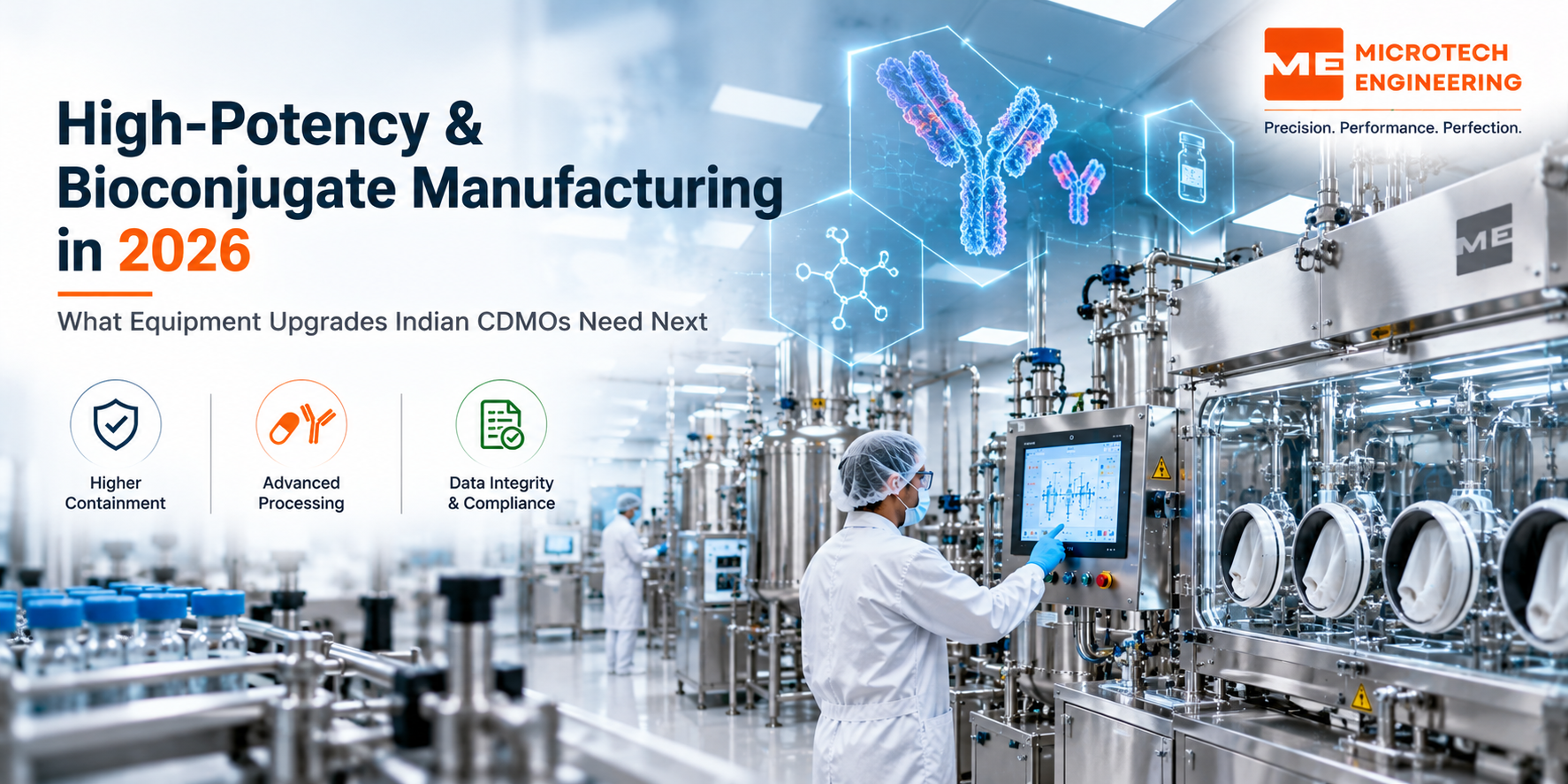
Pharmaceutical manufacturing is evolving toward increasingly complex molecules, targeted therapies and specialised production processes. Alongside conventional active pharmaceutical ingredients (APIs), manufacturers are evaluating opportunities in highly potent APIs (HPAPIs), antibody-drug conjugates (ADCs), peptides, complex small molecules and other advanced therapeutic modalities.
For Indian contract development and manufacturing organisations (CDMOs), these applications can create opportunities to expand technical capabilities and serve more specialised pharmaceutical programmes.
However, high-potency and bioconjugate manufacturing is not simply a matter of installing a larger reactor or adding a new mixing vessel. These processes introduce critical engineering challenges involving operator exposure, containment, cross-contamination, material compatibility, cleaning, process control and product quality.
The equipment strategy must reflect the chemistry, biological materials, process steps and hazards associated with the specific product. Industry guidance from the International Society for Pharmaceutical Engineering (ISPE) emphasises risk-based containment, engineering controls, containment-performance assessment and lifecycle management when handling potent compounds using modern high-potency pharmaceutical manufacturing equipment.
For Indian CDMOs planning manufacturing upgrades in 2026 and beyond, the priority should be to build equipment systems that are appropriate for the process, designed around containment risks, easier to clean, and ready for documented GMP operation.
What Is High-Potency and Bioconjugate Manufacturing?
Before evaluating equipment, it is important to distinguish between high-potency manufacturing and bioconjugate manufacturing.
What Is High-Potency API Manufacturing?
High-potency API manufacturing involves producing active pharmaceutical ingredients that can cause significant biological effects at relatively low exposure levels. Some HPAPIs require stringent controls to protect operators, prevent environmental release and minimise cross-contamination.
The required containment level depends on the compound's toxicological characteristics, exposure limits, process conditions and potential exposure routes. For this reason, equipment selection should be supported by an appropriate toxicological and industrial-hygiene assessment rather than a generic assumption that every HPAPI requires the same containment solution.
What Is Bioconjugate Manufacturing?
Bioconjugates are molecules created by linking a biological component to another molecule or functional component. A prominent pharmaceutical example is an antibody-drug conjugate (ADC), in which an antibody is linked to a drug payload through a chemical linker.
ADC manufacturing can involve biological intermediates, potent small-molecule payloads, conjugation reactions, purification and subsequent formulation. FDA inspection guidance identifies these as important elements in ADC manufacturing and inspection.
Depending on the product and process, a CDMO may need to manage:
- Biological material compatibility.
- Chemical payload containment.
- Controlled conjugation conditions.
- Purification of unconjugated payload.
- Product-quality attributes.
- Cleaning and cross-contamination controls.
- Temperature-controlled handling and storage.
Important distinction: HPAPI manufacturing and bioconjugate manufacturing overlap in some applications, but they are not interchangeable terms. Not every HPAPI is a bioconjugate, and not every bioconjugate has the same potency, containment or biological-control requirements.
Why Indian CDMOs Should Review Their Equipment Strategy in 2026
The move toward specialised pharmaceutical manufacturing creates a need to evaluate equipment beyond conventional capacity and throughput. CDMOs must consider whether a process can be operated safely, reproduced consistently, documented adequately and scaled cleanly.
- More complex process requirements: Bioconjugation and potent-compound manufacturing involve multiple process stages, different material-handling requirements and narrow operating windows.
- Containment and personnel protection: Handling potent compounds creates exposure risks during charging, sampling, transfer, discharge, cleaning and maintenance.
- Cross-contamination control: Multi-product CDMOs need to evaluate how equipment design, cleaning procedures, material transfer and facility arrangements work together to eliminate carryover.
- Documentation and qualification: Customers require detailed documentation on equipment design, materials, operating parameters, cleaning validation and qualification support.
- Future manufacturing flexibility: CDMOs must accommodate different customer programmes, batch sizes and product requirements via modular, adaptable designs.
6 Equipment Upgrades Indian CDMOs Should Prioritize
1. Closed Processing and Containment-Ready Equipment
For high-potency manufacturing, closed processing is one of the most critical design considerations. The aim is to minimise opportunities for potent materials to escape into the working environment or cross-contaminate other products.
However, a closed vessel alone does not establish adequate containment. Connections, charging, sampling, discharge, cleaning, maintenance and waste handling must also be engineered for safety. Systems to evaluate include:
- Closed reactors and process vessels.
- Contained charging and discharge arrangements.
- Isolators and barrier containment enclosures.
- Split butterfly valves (SBVs) or contained transfer ports.
- Closed, aseptic sampling systems.
- Contained powder-transfer equipment with HEPA filtration.
2. Upgrade Reactors, Mixing Systems and Process Vessels
Reactors and mixing vessels are central to both chemical conjugation and bio-handling. Key considerations include working and total volume, surface finish (e.g. electropolished SS316L with Ra < 0.4 μm), agitator design for low shear, jacketed temperature-control capability, full drainability, and sanitary instrumentation ports.
Automation features such as controlled reagent dosing, temperature profiling, agitator speed synchronization, and recipe management ensure batch-to-batch repeatability and safety.
3. Improve Contained Material Transfer and Sampling
Material transfer represents the highest exposure risk in potent manufacturing. Manual charging, open sampling, intermediate transfers, and vessel discharge can expose operators and the cleanroom environment.
CDMOs should map every transfer step—from raw material dispensing to waste removal—and implement closed transfer lines, contained docking systems, sanitary valve interfaces, and single-use transfer bags where appropriate.
4. Strengthen Cleaning Systems and Cross-Contamination Controls
In multi-product facilities, inadequate cleaning risks chemical or biological carryover. Automated clean-in-place (CIP) systems with validated spray coverage, zero dead-leg piping, drainable vessel bottoms, and monitoring of flow, temperature, conductivity and chemical concentration provide reproducible cleaning.
Cleaning validation acceptance criteria must be scientifically established based on health-based exposure limits (HBEL), toxicological evaluations, and total product-contact surface areas.
5. Evaluate Single-Use Technologies and Product-Contact Materials
Single-use systems can eliminate cleaning validation between campaigns in bioconjugation steps, but stainless steel remains superior for solvent resistance, pressure, temperature, and large-scale synthesis. Often, a hybrid approach yields optimal efficiency:
| Consideration | Stainless-Steel Systems | Single-Use Systems |
|---|---|---|
| Reuse | Designed for repeated, long-term use | Components generally used once |
| Cleaning | Requires validated CIP/SIP and verification | Eliminates cleaning validation for replaced contact parts |
| Material compatibility | Broad chemical and solvent compatibility | Requires extractables/leachables and solvent assessment |
| Waste | Cleaning effluent management | Solid consumable waste handling and disposal |
| Scale & Operating Conditions | High pressure, vacuum, wide temperature range | Subject to assembly and pressure/temperature limits |
| Containment | Engineered closed piping, valves, and seals | Aseptic connectors, bag integrity, contained disposal |
6. Modernise Automation, Instrumentation and Process Data
Potent operations benefit significantly from automated recipe control, electronic batch records (EBR), and integrated safety interlocks that prevent accidental opening of pressurized or contaminated vessels. Process data (temperature, pressure, agitation, dosing, flow rates) should be captured automatically with compliant audit trails.
Special Considerations for ADC and Bioconjugate Manufacturing
Antibody-drug conjugates combine a biological intermediate with a potent cytotoxic small molecule. Equipment trains must therefore address both biological product stability and rigorous toxic containment:
- Control of Biological Intermediates: Gentle handling, temperature-controlled jackets, and biocompatible product-contact surfaces to prevent protein denaturation.
- Controlled Conjugation Conditions: Precise stoichiometric reagent dosing, uniform mixing, and tight temperature control during the linker-payload binding reaction.
- Potent Payload Handling: High-containment isolators or closed transfer systems with nanogram-level occupational exposure limits (OELs).
- Purification and Unconjugated Payload Removal: Tangential flow filtration (TFF) and chromatography skids designed for contained operation and effective decontamination.
- Dual-Target Cleaning Validation: Cleaning procedures must be validated to degrade or remove both potent chemical residues and biological contaminants.
A Practical Equipment-Upgrade Roadmap for Indian CDMOs
Rather than rebuilding entire suites at once, CDMOs can follow a phased modernisation pathway:
- Phase 1: Process and Risk Assessment – Establish compound toxicology, OEL bands, process steps, exposure scenarios, and cleaning thresholds.
- Phase 2: Equipment Gap Assessment – Audit existing vessels, transfer connections, sampling ports, and automation capabilities against containment targets.
- Phase 3: Prioritise Critical Upgrades – Implement contained transfer, hygienic vessel upgrades, and CIP improvements first on critical high-risk lines.
- Phase 4: Engineering and Qualification Planning – Prepare comprehensive URS, execute DQ/IQ/OQ/PQ protocols, and conduct surrogate powder containment testing (SMEPAC).
- Phase 5: Operational Performance Verification – Validate cleaning methods, monitor exposure monitoring data, and audit computerized batch records.
Conclusion
High-potency and bioconjugate manufacturing offers immense commercial potential for Indian CDMOs, but success requires purpose-built engineering, stringent containment, cleanable equipment design, and robust automation.
For more insights on upgrading your facility, explore our technical guide on high-potency & bioconjugate manufacturing in 2026 and evaluate your process containment requirements before investing in your next equipment line.