
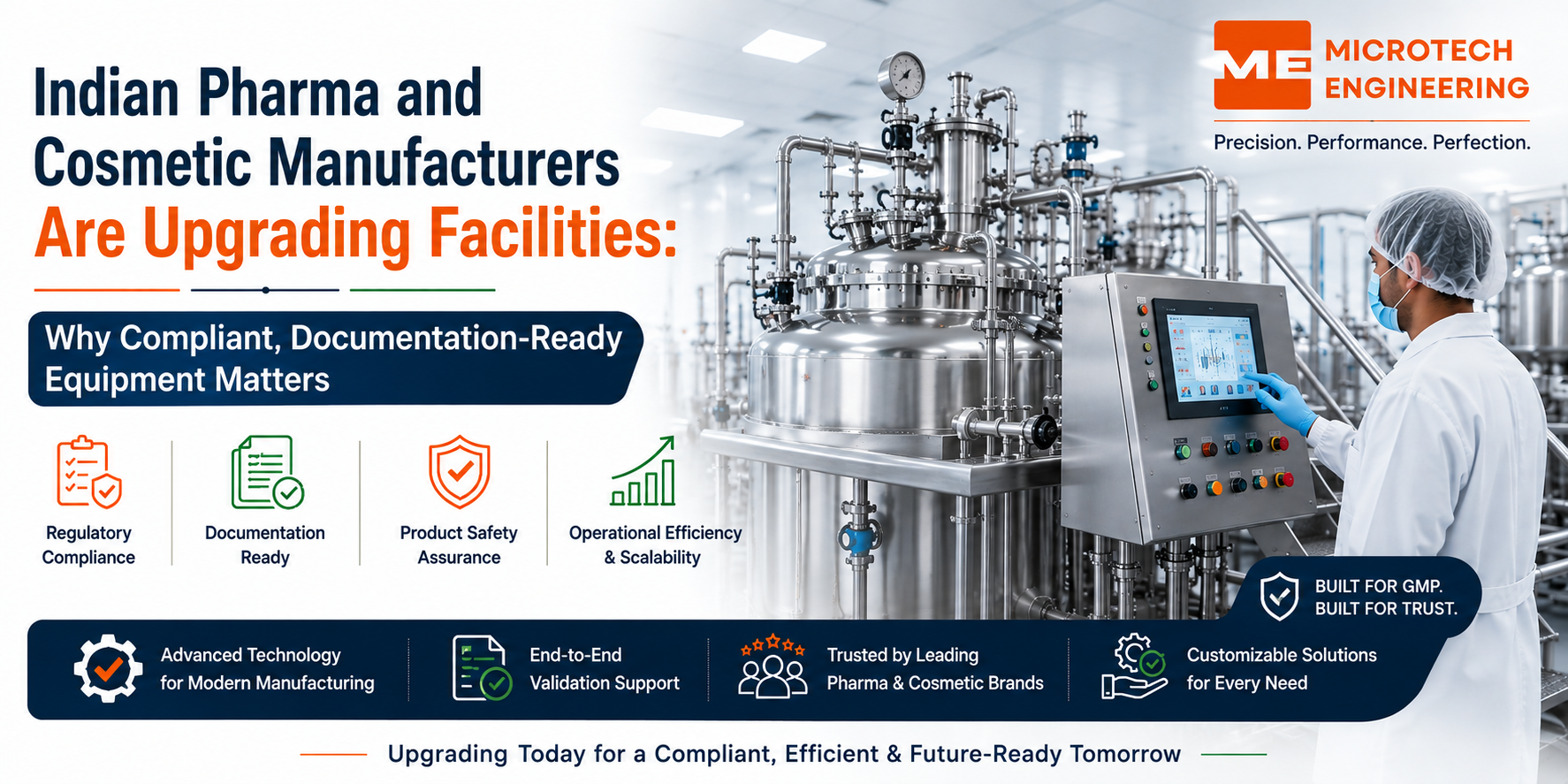
Indian pharmaceutical and cosmetic manufacturers are increasingly investing in facility upgrades, capacity expansion, automation, and modern processing infrastructure.
For many manufacturers, growth is no longer only about adding more machines or increasing batch sizes. New production requirements are creating a greater need for equipment that is easier to clean, easier to control, easier to document, and better aligned with Good Manufacturing Practice requirements.
As pharmaceutical and cosmetic businesses expand into new markets, work with contract manufacturing partners, introduce new product categories, or modernize existing facilities, equipment selection is becoming a more strategic decision.
Manufacturers are now evaluating not only the mechanical performance of a machine but also its material of construction, hygienic design, automation capability, cleaning requirements, documentation, qualification support, calibration requirements, process traceability, and long-term scalability. This is increasing the demand for compliant, documentation-ready pharmaceutical and cosmetic manufacturing equipment.
In this article, we explore why Indian manufacturers are upgrading their facilities and what they should consider when selecting process equipment for pharmaceutical and cosmetic production.
Why Are Pharma and Cosmetic Manufacturers Upgrading Their Facilities?
Several factors are influencing investment in modern manufacturing infrastructure.
1. Growing Production Capacity
Manufacturers are expanding to meet increasing demand for pharmaceutical products, personal care products, cosmetics, nutraceuticals, and contract manufacturing services. Increasing production capacity may require larger manufacturing vessels, additional processing lines, improved material transfer systems, better storage infrastructure, automated cleaning systems, and improved process control. However, increasing capacity without improving process design can create operational challenges. For this reason, manufacturers are increasingly evaluating complete processing systems rather than simply adding standalone equipment.
2. Higher Expectations for Quality and Process Control
Pharmaceutical and cosmetic products must be manufactured consistently. Even small variations in temperature, mixing speed, processing time, ingredient addition, homogenization, and product transfer can affect the final product. Modern manufacturing equipment helps manufacturers establish more controlled and repeatable processes. Automation and digital controls can assist with maintaining predefined parameters, reducing operator dependency, monitoring process conditions, recording critical process data, managing alarms, and improving batch consistency. This is particularly important for manufacturers producing multiple products on the same production line.
3. Facility Modernization and Automation
Many older manufacturing facilities depend heavily on manual operations. While manual systems can be effective, they may create challenges related to operator-dependent processes, manual valve operation, manual documentation, limited process visibility, higher risk of operating variation, and difficulties in scaling production. Modern pharmaceutical and cosmetic processing plants increasingly integrate PLC systems, HMI interfaces, automated valves, digital temperature controls, flow monitoring, level sensors, recipe management, SCADA systems, and automated CIP systems. Manufacturers can also upgrade existing facilities in phases rather than replacing the entire production system at once.
4. The Growth of Contract Manufacturing and Partnerships
Contract manufacturing and strategic partnerships are increasing the importance of standardized production infrastructure. When manufacturers produce products for multiple brands or clients, they may need to demonstrate consistent manufacturing capability. This creates additional focus on equipment documentation, process repeatability, cleaning procedures, batch traceability, calibration, maintenance, and change control. A well-documented equipment system makes it easier to demonstrate how manufacturing operations are controlled.
What Does Documentation-Ready Equipment Mean?
Documentation-ready equipment refers to machinery that is supplied with, or can be supported by, the technical and quality documentation required for its intended pharmaceutical or cosmetic manufacturing application.
Depending on the project, this may include:
- Equipment specifications
- General arrangement drawings
- Process and instrumentation information
- Material certificates and product-contact material details
- Surface-finish information
- Electrical drawings and instrument specifications
- FAT documentation and calibration certificates
- Operating manuals and maintenance manuals
- Spare-parts lists
- Automation documentation (PLC and HMI information)
The exact documentation package should be defined before equipment manufacturing begins. This is important because documentation requirements vary depending on product type, manufacturing process, facility requirements, regulatory expectations, customer quality systems, and intended export markets.
Why GMP-Compliant Equipment Design Matters
For pharmaceutical manufacturing, equipment design plays a critical role in maintaining product quality and controlling contamination risks. Important considerations include appropriate material of construction, hygienic product-contact surfaces, smooth internal finishes, proper welding, drainability, reduced dead-leg areas, compatible seals and gaskets, cleaning accessibility, CIP compatibility, and automation options.
For cosmetic manufacturing, similar principles apply, particularly for products such as creams, lotions, gels, serums, shampoos, liquid soaps, and personal care products. The level of GMP requirements and documentation may differ depending on the product category and applicable standards, but hygienic design and process control remain important.
Essential Equipment Being Upgraded
1. Liquid Processing Plants
Liquid processing plants are used in pharmaceutical and cosmetic manufacturing for products such as syrups, oral solutions, suspensions, liquid supplements, shampoos, body washes, liquid soaps, and cosmetic liquids. Modern systems may include automated mixing, heating, cooling, product transfer, filtration, and CIP functionality.
2. Ointment and Cream Manufacturing Plants
Cream and ointment manufacturing requires precise control over mixing, heating, cooling, and homogenization. Upgraded systems may include vacuum processing, high-shear homogenization, jacketed vessels, automated temperature control, programmable mixing, and automated product transfer. These features can improve product consistency and production efficiency.
3. Stainless Steel Mixing Vessels
Mixing vessels remain essential across pharmaceutical and cosmetic manufacturing. Modern vessels may include SS316L product-contact parts where appropriate, jacketed heating and cooling, variable-speed agitators, homogenizers, load cells, temperature sensors, and automated controls. Equipment should be designed according to the formulation and processing requirements.
4. Storage Tanks
Storage systems are used for raw materials, purified water, process liquids, intermediate products, and finished products. Modern storage tanks can include level monitoring, temperature monitoring, agitation, spray devices, hygienic venting, and controlled product transfer.
5. CIP Systems
Clean-in-Place systems are becoming increasingly important as manufacturers look to improve cleaning consistency and reduce manual effort. Automated CIP systems may control cleaning solution preparation, temperature, flow, cleaning duration, rinsing, and chemical dosing. A properly designed CIP system can support repeatable cleaning processes across multiple vessels and process lines.
The Importance of Equipment Qualification
For pharmaceutical manufacturers, equipment qualification is an important part of demonstrating that a system is suitable for its intended use. A qualification lifecycle may include:
- Design Qualification (DQ): Verification that the proposed equipment design meets predefined requirements.
- Installation Qualification (IQ): Verification that equipment is installed according to approved specifications.
- Operational Qualification (OQ): Verification that the equipment operates within defined parameters.
- Performance Qualification (PQ): Verification that the equipment or process performs consistently under intended operating conditions.
The level of qualification should be determined according to equipment criticality, intended use, risk, and the manufacturer's quality system.
Calibration Is Becoming a Key Equipment Requirement
Modern manufacturing equipment relies on instruments and sensors such as temperature sensors, pressure gauges, flow meters, load cells, level sensors, vacuum instruments, pH meters, and conductivity sensors. For critical measurements, manufacturers need an appropriate calibration programme to ensure that instruments provide reliable information.
Equipment procurement should therefore consider instrument type, measurement range, accuracy, calibration requirements, traceability, maintenance, and replacement availability. Selecting the right instrumentation during the design stage can simplify long-term maintenance and audit preparation.
Automation and Data Are Changing Equipment Choices
Manufacturers are increasingly looking beyond mechanical specifications. They also want equipment that can support PLC automation, HMI monitoring, SCADA integration, recipe management, alarm recording, data logging, user access controls, batch information, and equipment performance monitoring. This is especially relevant for facilities manufacturing multiple products or operating several production lines.
What Manufacturers Should Check Before Buying New Equipment
Before placing an order, pharmaceutical and cosmetic manufacturers should define their requirements through a clear User Requirement Specification (URS). Key areas to review include:
- Process Requirements: Product type, batch size, viscosity, mixing, heating/cooling, homogenization, transfer requirements.
- Material Requirements: Product-contact materials, surface finish, corrosion resistance, gaskets and seals.
- Cleaning Requirements: Manual cleaning, CIP, SIP where applicable, cleaning validation requirements.
- Automation Requirements: Manual, semi-automatic, fully automated, PLC, HMI, SCADA, recipe management.
- Documentation Requirements: Drawings, material certificates, FAT, SAT, IQ/OQ support, calibration documentation, manuals.
The Shift from “Machine Purchase” to “Engineering Partnership”
The way manufacturers purchase equipment is changing. Previously, equipment selection focused primarily on capacity, price, and delivery time. Today, the evaluation process includes process expertise, customization, hygienic design, automation, documentation, qualification support, installation, commissioning, after-sales service, and long-term maintenance. This means pharmaceutical and cosmetic manufacturers are increasingly looking for engineering partners rather than simply machinery suppliers.
How to Select the Right Equipment Manufacturer
When evaluating a pharmaceutical or cosmetic equipment manufacturer, consider manufacturing capability, industry experience, customization, documentation, automation integration, installation support, and after-sales service.
The Future of Pharma and Cosmetic Manufacturing Equipment in India
The next generation of manufacturing equipment will be increasingly automated, connected, data-driven, energy-efficient, easier to clean, easier to monitor, scalable, and documentation-ready. Choosing scalable equipment can reduce the complexity of future upgrades.
Conclusion
Indian pharmaceutical and cosmetic manufacturers are moving toward more controlled, efficient, and scalable manufacturing environments. As facilities expand and partnerships increase, the demand for compliant, documentation-ready manufacturing equipment is becoming more important.
Modern equipment selection is no longer only about purchasing a machine with the required production capacity. Manufacturers must also consider hygienic design, material compatibility, process control, automation, cleaning, calibration, qualification, documentation, maintenance, and scalability. Selecting the right equipment partner ensures that the processing system is designed not only for today's production requirements but also for future operational and compliance needs.