
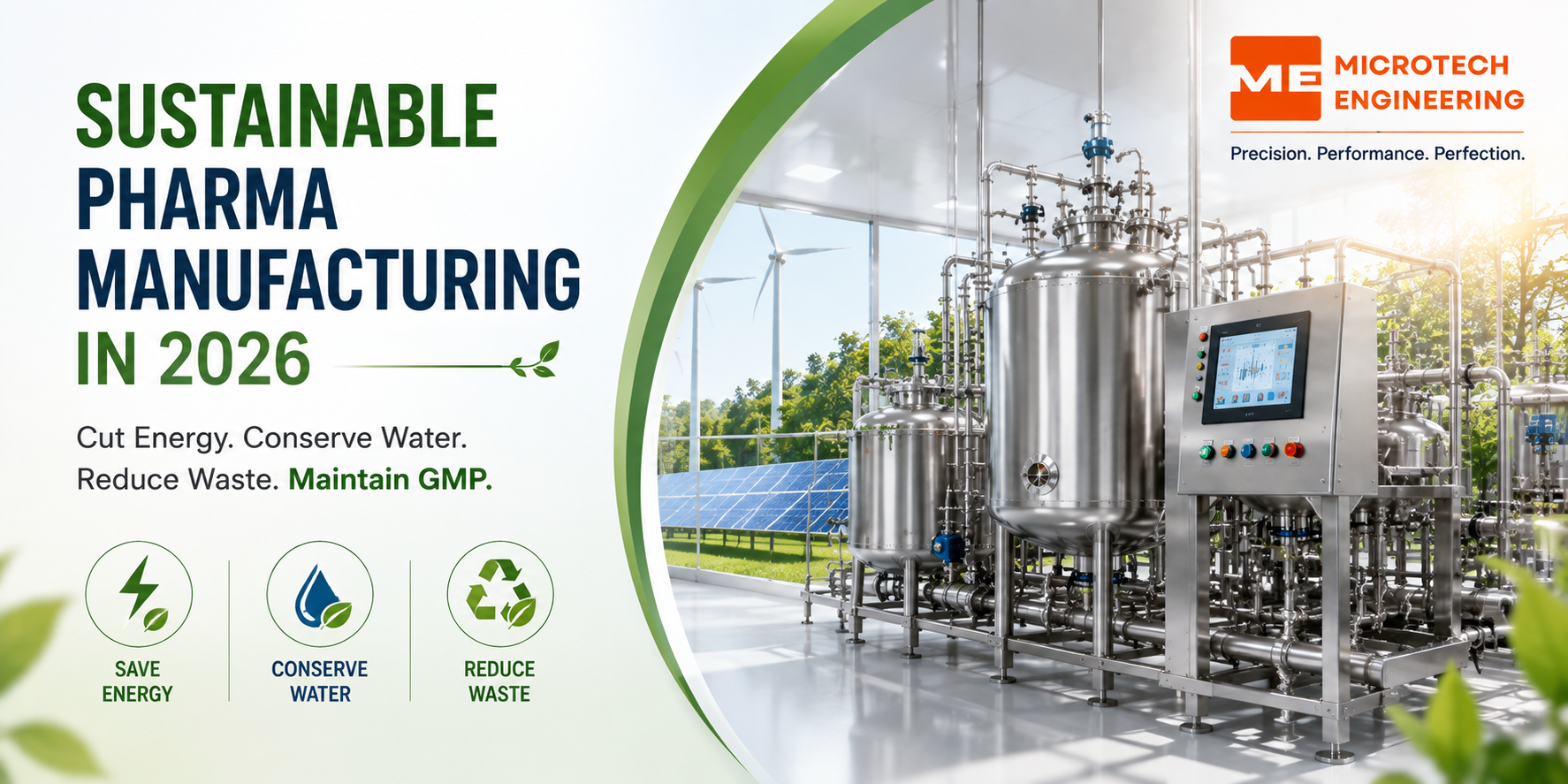
Sustainability is becoming an increasingly important consideration for pharmaceutical manufacturers.
Pharmaceutical production requires significant amounts of energy, water, process utilities, cleaning resources, packaging materials, and other inputs. At the same time, manufacturers must maintain strict standards for product quality, hygiene, contamination control, process consistency, and Good Manufacturing Practice (GMP).
This creates an important challenge:
How can pharmaceutical manufacturers reduce energy, water, and waste without compromising GMP or product quality?
The answer is not simply to consume fewer resources.
Instead, manufacturers need to identify where resources are being consumed unnecessarily and use better equipment design, automation, process optimization, monitoring, preventive maintenance, and utility management to improve efficiency.
In 2026, sustainable pharmaceutical manufacturing is increasingly moving from a corporate sustainability initiative toward an engineering and operational priority.
For Indian pharmaceutical manufacturers, this creates opportunities to modernize existing facilities and select more efficient sustainable pharmaceutical equipment for new plants.
What Is Sustainable Pharmaceutical Manufacturing?
Sustainable pharmaceutical manufacturing involves producing medicines and healthcare products while minimizing environmental impact and efficiently using resources such as:
- Energy
- Water
- Raw materials
- Cleaning chemicals
- Process utilities
- Packaging materials
The objective is to reduce environmental impact while maintaining:
- GMP requirements
- Product quality
- Patient safety
- Process consistency
- Contamination control
- Regulatory compliance
A sustainable pharmaceutical facility should therefore not be viewed as simply a “green factory.”
It should be a well-controlled, efficient manufacturing system where resource consumption is measured, optimized, and continuously improved.
Why Sustainability Matters for Pharma Manufacturing in 2026
Pharmaceutical manufacturers face increasing pressure to improve operational efficiency while maintaining high quality standards.
Some of the major drivers include:
Rising Energy Costs
Heating, cooling, HVAC, compressed air, chilled water, pumps, motors, and process equipment can contribute significantly to a manufacturing facility’s energy consumption.
Water Consumption
Water may be required for:
- Cleaning
- Purified water systems
- Process operations
- Equipment washing
- Utility systems
- Rinsing
Reducing unnecessary water consumption can provide both environmental and operational benefits.
Manufacturing Waste
Waste can originate from:
- Product losses
- Raw material handling
- Failed batches
- Cleaning processes
- Packaging
- Disposable materials
- Effluent
- Rejected products
Facility Expansion
As pharmaceutical manufacturers increase production capacity, inefficient equipment and processes can multiply resource consumption.
Facility expansion therefore provides an opportunity to redesign processes with efficiency in mind.
Can Sustainability and GMP Work Together?
Yes.
In fact, many sustainability improvements can also improve process control and operational consistency.
For example:
- Automated cleaning → controlled water usage → repeatable cleaning process
- Efficient heating → lower energy consumption → better temperature control
- Automated process control → fewer manual errors → reduced batch variability
- Leak detection → lower utility consumption → improved equipment reliability
The key is to ensure that sustainability initiatives do not reduce the effectiveness of critical GMP processes.
Resource reduction should always be evaluated through appropriate quality and risk-management processes.
1. Reduce Energy Consumption Through Better Process Equipment
Energy consumption can come from numerous systems within a pharmaceutical plant.
These may include:
- Manufacturing vessels
- Agitators
- Homogenizers
- Pumps
- Heating systems
- Cooling systems
- HVAC
- Compressed air
- Water systems
- Refrigeration
- Electrical systems
One of the most effective approaches is to identify the largest energy-consuming processes and optimize them.
Energy-Efficient Pharmaceutical Processing Equipment
Modern equipment can be designed to minimize unnecessary energy consumption.
Examples include:
High-Efficiency Motors
Efficient motors can reduce electricity consumption in pumps, agitators, and other rotating equipment.
Variable Frequency Drives
VFDs allow motor speed to be adjusted according to process requirements instead of operating continuously at maximum speed. For example, a transfer pump may not need to operate at full capacity throughout the entire production cycle. Controlling its speed can potentially reduce unnecessary energy consumption.
Optimized Heating and Cooling
Jacketed vessels with appropriate insulation and temperature controls can improve thermal efficiency. Instead of continuously heating or cooling at maximum capacity, automated control systems can maintain the required process temperature more precisely.
2. Optimize Pharmaceutical Mixing Processes
Mixing can be an energy-intensive operation, particularly for high-viscosity products.
The objective should not simply be to use a more powerful agitator.
Instead, manufacturers can evaluate:
- Impeller design
- Agitator speed
- Product viscosity
- Vessel geometry
- Mixing time
- Batch size
- Motor efficiency
An appropriately designed mixing system can achieve the required process performance without unnecessarily increasing energy consumption.
For new equipment projects, process requirements should therefore be considered before selecting motor capacity and agitation systems.
3. Reduce Water Consumption Through Better Cleaning Systems
Water consumption is one of the major sustainability considerations in pharmaceutical manufacturing.
Cleaning operations can require substantial amounts of:
- Purified water
- Water for injection where applicable
- Cleaning solutions
- Rinse water
However, reducing water consumption does not mean simply reducing cleaning.
The goal is: Use the right amount of water to achieve the required cleaning outcome.
How Automated CIP Can Reduce Water Waste
Clean-in-Place (CIP) systems can help standardize cleaning processes.
An automated CIP system can control parameters such as:
- Cleaning time
- Flow rate
- Temperature
- Cleaning solution concentration
- Rinse duration
This can reduce the variation associated with manual cleaning procedures.
For example, a manually operated cleaning cycle may continue longer than necessary because the operator has limited visibility into the actual process endpoint. An automated system can execute a predefined cleaning recipe according to established parameters.
This may help manufacturers identify opportunities to optimize:
- Water volume
- Cleaning duration
- Chemical consumption
- Heating requirements
Any reduction should be validated or otherwise appropriately demonstrated according to the applicable cleaning strategy and quality system.
4. Reuse and Optimize Water Where Appropriate
Water management should be considered across the entire pharmaceutical facility.
Potential areas for investigation include:
- Equipment cleaning
- Cooling systems
- Utility systems
- Reverse osmosis systems
- Water-treatment processes
- Rinsing operations
- Non-product-contact applications
However, water reuse must be carefully distinguished by application.
Water used in critical pharmaceutical processes cannot simply be reused because it is environmentally beneficial. The quality of water required for a specific application must always be maintained.
Therefore, manufacturers should conduct a risk-based water balance and identify where optimization or reuse is technically and GMP appropriate.
5. Reduce Product and Raw Material Waste
Sustainability is not only about water and electricity.
Every kilogram of rejected product or unused raw material represents:
- Material cost
- Energy used in processing
- Water used in cleaning
- Packaging resources
- Manufacturing time
Reducing batch variability can therefore contribute directly to sustainability.
Process automation can help improve repeatability by controlling:
- Ingredient addition
- Mixing time
- Temperature
- Agitation speed
- Homogenization
- Transfer
- Process sequencing
Better process control can reduce the likelihood of avoidable process deviations and product losses.
6. Minimize Product Loss During Transfer
Product transfer can create losses, particularly with viscous pharmaceutical and cosmetic formulations.
Potential causes include:
- Poor piping design
- Inappropriate pipe diameter
- Unnecessary pipe length
- Dead legs
- Product remaining in vessels
- Inefficient pumps
- Poor drainage
- Manual transfer procedures
Hygienic process design can help minimize residual product.
When designing pharmaceutical process systems, manufacturers should consider:
- Pipe routing
- Drainability
- Vessel outlet design
- Pump selection
- Valve arrangement
- Product viscosity
- Transfer distance
The objective is to maximize product recovery while maintaining hygienic and GMP-appropriate design.
7. Improve Equipment Insulation
Heating and cooling systems can lose energy when equipment and piping are poorly insulated.
Potential areas include:
- Manufacturing vessels
- Hot-water lines
- Steam systems
- Product pipelines
- Heating jackets
- Utility lines
Appropriate insulation can help maintain process temperatures while reducing unnecessary heat loss. This is particularly relevant for processes requiring controlled heating or cooling for extended periods.
8. Use Automation to Monitor Resource Consumption
You cannot optimize what you do not measure.
Modern pharmaceutical plants can integrate sensors and automation systems to monitor:
- Electricity consumption
- Water usage
- Steam consumption
- Compressed air
- Temperature
- Pressure
- Flow
- Equipment runtime
PLC and SCADA systems can provide centralized visibility into these parameters. This can help engineering teams identify abnormal consumption, equipment inefficiencies, utility leaks, excessive operating times, and process bottlenecks.
9. Predictive Maintenance Can Reduce Waste
Equipment that is not properly maintained can consume more resources.
For example:
- A poorly maintained pump may require more energy.
- A leaking valve may waste water.
- An inefficient heat exchanger may require more energy to achieve the same temperature.
- A failing agitator may increase processing time.
Preventive and predictive maintenance can therefore support sustainability. Maintenance teams can monitor motor performance, vibration, temperature, pressure, flow, operating hours, and energy consumption. Data-driven maintenance strategies can help identify equipment deterioration before it results in major failures.
10. Reduce Cleaning Chemicals
Cleaning chemicals have environmental and operational impacts.
An optimized CIP process can help manufacturers evaluate:
- Chemical concentration
- Cleaning temperature
- Contact time
- Flow rate
- Rinse duration
The objective is not to reduce chemical use arbitrarily. Instead, the cleaning process should be designed to achieve the required cleaning performance using controlled and repeatable parameters.
This approach can potentially reduce chemical consumption, wastewater load, cleaning time, water consumption, and energy used for heating cleaning solutions.
11. Improve Pharmaceutical Plant Automation
Automation is one of the strongest links between sustainability and modern pharmaceutical manufacturing.
An automated system can control process parameters more consistently than highly manual processes.
Manual Process: Operator → checks temperature → adjusts valve → checks level → changes mixer speed → records values
Automated Process: Sensor → PLC → control logic → actuator → HMI/SCADA → data record
Automation can improve process consistency, resource control, data visibility, production efficiency, and repeatability. It can also provide historical data that helps engineers identify opportunities for continuous improvement.
12. Upgrade Older Pharmaceutical Equipment
Sustainability does not always require building an entirely new facility. Existing pharmaceutical plants may have opportunities for automation retrofitting.
Potential upgrades include:
- New PLC systems
- HMI panels
- Variable frequency drives
- Energy-efficient motors
- Digital sensors
- Automated valves
- Improved instrumentation
- SCADA monitoring
- Automated CIP controls
Retrofitting can allow manufacturers to improve efficiency while continuing to use suitable existing mechanical equipment. The feasibility of each upgrade should be evaluated based on equipment condition, process criticality, safety, validation requirements, and lifecycle cost.
13. Design New Pharma Plants for Efficiency
When building a new pharmaceutical facility, sustainability should be considered during the design stage rather than added later.
Important areas include:
Equipment Layout: Shorter and more efficient process routes can reduce pumping requirements and product losses.
Utility Planning: Utility systems should be sized according to actual process requirements.
Equipment Selection: Select equipment based on required capacity, energy efficiency, cleaning requirements, maintenance, automation, and lifecycle cost.
Process Integration: Where appropriate, integrate manufacturing vessels, storage tanks, pumps, filtration, CIP, and automation. A well-integrated system can reduce unnecessary transfers and manual intervention.
14. Track Sustainability KPIs
A pharmaceutical manufacturer cannot effectively manage sustainability without measurable indicators.
Useful KPIs may include:
Energy:
- kWh per batch
- kWh per kg of product
- HVAC energy consumption
- Equipment energy consumption
Water:
- Litres of water per batch
- Water consumption per kg
- CIP water consumption
- Purified water consumption
Waste:
- Product waste per batch
- Raw material loss
- Packaging waste
- Wastewater generation
Equipment:
- Equipment utilization
- Downtime
- Maintenance frequency
- OEE
Tracking these metrics over time can reveal whether equipment upgrades and process improvements are producing measurable results.
15. Sustainability Should Not Compromise GMP
This is the most important principle.
A pharmaceutical manufacturer should never reduce a critical GMP control simply to achieve a sustainability target.
For example: Do not reduce cleaning time simply to save water. Instead: Optimize the cleaning process based on scientifically justified and validated parameters.
Similarly: Do not reduce HVAC requirements simply to reduce energy consumption. Instead: Optimize HVAC operation while maintaining the required environmental conditions.
Sustainability initiatives should therefore be evaluated alongside quality risk management, process validation, cleaning validation, equipment qualification, change control, environmental requirements, and applicable GMP requirements.
A Practical Sustainability Checklist for Pharma Manufacturers
Manufacturers planning a facility upgrade can use this checklist:
Energy:
- ☐ Identify major energy-consuming equipment
- ☐ Evaluate motor efficiency
- ☐ Assess VFD opportunities
- ☐ Inspect equipment insulation
- ☐ Optimize heating/cooling cycles
- ☐ Monitor equipment energy consumption
- ☐ Review HVAC efficiency
Water:
- ☐ Measure water consumption
- ☐ Establish a water balance
- ☐ Review CIP cycles
- ☐ Optimize rinse duration where scientifically justified
- ☐ Evaluate water recovery/reuse opportunities
- ☐ Check for leaks
- ☐ Monitor utility consumption
Waste:
- ☐ Measure product losses
- ☐ Review raw material wastage
- ☐ Evaluate transfer losses
- ☐ Optimize process yield
- ☐ Review cleaning chemical consumption
- ☐ Monitor wastewater generation
Equipment:
- ☐ Evaluate equipment age
- ☐ Assess automation opportunities
- ☐ Review instrumentation
- ☐ Check maintenance history
- ☐ Evaluate retrofit opportunities
- ☐ Review equipment lifecycle costs
GMP:
- ☐ Evaluate impact on validated processes
- ☐ Follow change control
- ☐ Assess qualification requirements
- ☐ Maintain calibration
- ☐ Maintain cleaning controls
- ☐ Document modifications
- ☐ Review data integrity requirements
The Role of Pharmaceutical Equipment Manufacturers
Equipment manufacturers have an important role to play in helping pharmaceutical companies achieve sustainability objectives.
The conversation between manufacturer and buyer should go beyond: “What is the capacity of the vessel?”
It should also address:
- How much energy does the system require?
- How efficient is the mixing system?
- How is the equipment cleaned?
- Can CIP be automated?
- How much water does the cleaning cycle require?
- Can the system be integrated with PLC/SCADA?
- Can energy and water consumption be monitored?
- How can product losses be minimized?
- Can the equipment be retrofitted later?
These questions can influence the total lifecycle cost and environmental impact of the equipment.
How Microtech Engineering Supports Modern Pharma Manufacturing
Microtech Engineering provides pharmaceutical process equipment and plant solutions designed around specific manufacturing requirements.
Its equipment and systems can include:
- Liquid Oral Processing Plants
- Ointment Manufacturing Plants
- Pharmaceutical Mixing Systems
- Stainless Steel Process Equipment
- Storage Tanks
- Pressure Vessels
- CIP Systems
- Process Automation
- Automation Retrofitting
For manufacturers planning a new facility or upgrading an existing plant, equipment can be evaluated not only for production capacity but also for hygienic design, automation, cleaning, process control, energy efficiency, water optimization, documentation, and future scalability.
The Future of Sustainable Pharma Manufacturing
The next phase of pharmaceutical manufacturing will increasingly combine sustainability with digitalization.
Future manufacturing systems are likely to place greater emphasis on:
- Real-time utility monitoring
- AI-assisted process optimization
- Predictive maintenance
- Digital twins
- Smart sensors
- Automated CIP
- Energy monitoring
- Automated batch control
- Advanced process analytics
- Connected equipment
The result is not simply a “greener” pharmaceutical plant. It is a manufacturing facility that can measure, control, and continuously improve resource consumption while maintaining quality and process requirements.
Conclusion
Sustainable pharmaceutical manufacturing in 2026 is not about choosing between environmental responsibility and GMP.
The objective is to design manufacturing processes where efficiency, quality, compliance, and sustainability work together.
Pharmaceutical manufacturers can identify opportunities to reduce resource consumption through energy-efficient equipment, optimized mixing, automated CIP, better water management, improved product transfer, efficient heating and cooling, automation, predictive maintenance, equipment retrofits, and real-time monitoring.
The most effective improvements begin at the engineering and equipment-selection stage.
For Indian pharmaceutical manufacturers planning a new plant, capacity expansion, or modernization project, sustainability should therefore be included in the equipment specification from the beginning.
The future of pharma manufacturing is not simply more production. It is smarter, more controlled, more efficient, and more sustainable production—without compromising the quality systems that protect the product and the patient.