
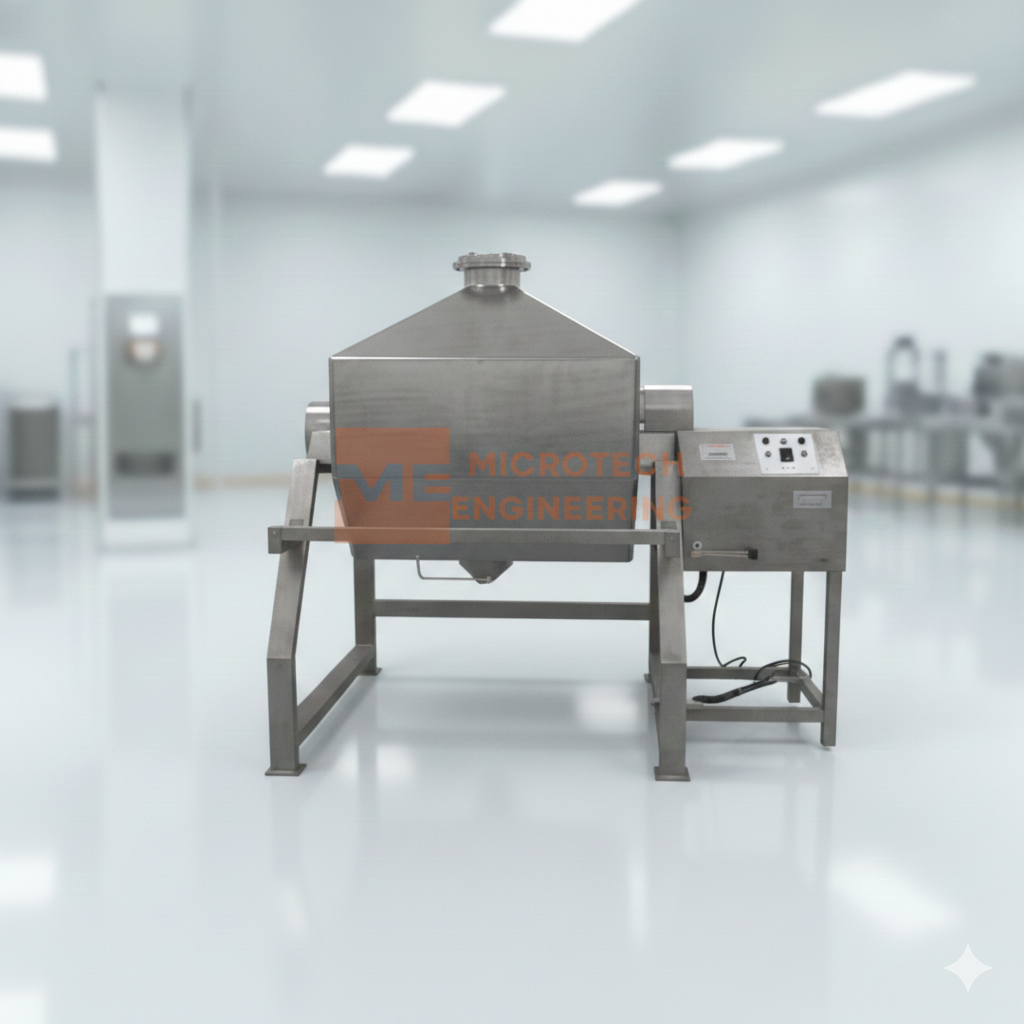
Blending dry powders is a crucial step in the production of solid dosage forms like tablets and capsules. Achieving content uniformity—ensuring that the active pharmaceutical ingredient (API) is evenly distributed throughout the batch—is a major challenge. The SS Octagonal Blender has emerged as one of the most popular tumbling blenders in the industry. Let's look at why its design is so effective.
The Blending Challenge: Segregation & Dead Zones
When blending dry powders, two major issues can arise:
- Particle Segregation: Differences in particle size, shape, and density can cause powders to separate, with larger particles settling in different areas than smaller ones.
- Dead Zones: Corners or areas in a blending vessel where material remains stationary instead of mixing. Cylindrical and V-cone blenders sometimes suffer from these stagnation points depending on powder characteristics.
The Physics & Geometry of the Octagonal Blender
Unlike standard cylindrical blenders, an octagonal blender is shaped as a multi-faceted shell. When rotated on its horizontal axis, this geometry creates three distinct mixing mechanisms:
1. Radial & Axial Material Movement
As the octagonal blender rotates, the powder slides along the flat faces. Because of the angled geometry, the powder is constantly diverted both radially (towards the center) and axially (along the sides). This dual-axis movement creates a highly chaotic flow path, ensuring thorough dispersion of the API within the excipients.
2. Safe, Gentle Blending without Baffles
Many blenders use internal ribbon blades or rotating paddles to force mixing. While effective, these mechanical agitators generate shear force and heat, which can damage delicate granules or break crystalline APIs. An octagonal blender relies on a gentle tumbling action. It requires no internal baffles or blades, protecting fragile granules from degradation while still achieving homogeneous blends.
3. 100% Discharge with Minimal Residue
The octagonal shell tapers symmetrically to a central discharge point, which is typically fitted with a sanitary butterfly valve. As a result, the blender drains completely by gravity, leaving virtually zero product residue. This is a critical advantage for cleaning validation and batch yield calculations.
Key Operating Parameters
To maximize the efficiency of an octagonal blender, engineers should tune three primary variables:
- Working Volume: Tumbling blenders should never be filled to 100% capacity. The ideal working volume is between 40% to 60% of the total geometric volume, leaving enough head space for the powder to cascade during rotation.
- Rotational Speed: Speed is typically controlled via a Variable Frequency Drive (VFD) between 5 to 20 RPM. If the blender rotates too fast, centrifugal force will hold the powder against the outer shell, preventing mixing. If it rotates too slowly, the cascading action will be insufficient.
- In-Process Charging: For dust-free operations, octagonal blenders can be directly loaded via IPC (In-Process Control) bins, using closed-loop connections to keep the cleanroom free of airborne particulates.
Conclusion
The SS Octagonal Blender represents an optimal combination of gentle material handling, geometric blending efficiency, and sanitary design. For pharmaceutical tablet plants producing medium to large batches, it remains a reliable choice for meeting strict USP/BP content uniformity tests.